
While political candidates in the United States secure headlines by shooting down Flock Safety artificial intelligence surveillance cameras, and civil rights groups campaign fiercely to dismantle private tracking networks, the United Kingdom continues to operate one of the most extensive vehicle surveillance operations in the world with absolute public indifference.
New data contrasting the two systems reveals that the UK’s National Automatic Number Plate Recognition (ANPR) network is far more invasive regarding data retention than its controversial American counterpart, yet it faces virtually zero political or social friction.
A direct comparison of the infrastructure highlights a fundamental divergence in privacy tolerances and data ownership in what could be called The Transatlantic Surveillance Divide.
The standard data retention policy for US-based Flock Safety cameras is 7 days. In stark contrast, the UK network stores individual travel histories for up to 1 year. But it gets worse – the UK’s state-run network logs over 100 million vehicle movements every single day using roughly 14,000 cameras.
Flock Safety is a venture-backed private corporation selling access to law enforcement, neighborhood associations, and schools. The UK’s ANPR system is completely state-controlled by the Home Office, sharing data across the Police, HMRC, Border Force, and the Department for Work and Pensions.
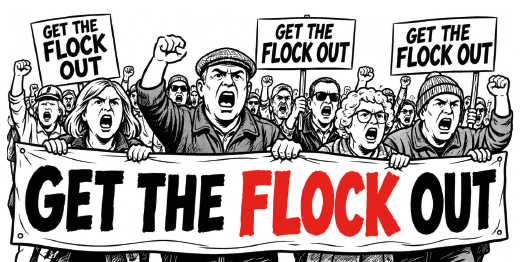
Privacy advocates point to several key factors explaining why British citizens remain compliant under a network that tracks millions of innocent journeys daily.
Firstly, the commercialisation of movement by private tech startups in the US sparks immediate dystopian anxiety. Conversely, British citizens historically exhibit a higher tolerance for state-run data custody than private entities profiting from surveillance.
In the UK, a pervasive societal attitude treats automated tracking as an implicit safety net. Warnings from regulatory bodies that millions of citizens with no criminal involvement are having their movements logged have failed to spark public debate.
With the UK already ranking among the most heavily blanketed CCTV nations in the world, the evolution to automated, intelligent tracking has been viewed by the public as a gradual technological upgrade rather than a sudden intrusion. A normalisation of sorts.
The network operates with minimal parliamentary oversight. Recent legislative discussions have focused almost entirely on criminals using “ghost plates” to evade cameras, rather than the civil liberties implications of the system itself. Furthermore, Freedom of Information (FOI) requests seeking deeper technical accountability are routinely blocked on national security grounds.
While vehicle tracking has been quietly absorbed into the fabric of British life, privacy watchdogs warn that the battle lines are shifting. Human rights organisations are actively mobilising against the rapid expansion of Live Facial Recognition (LFR) in major transit hubs and supermarkets, calling it an indiscriminate tool that reverses the presumption of innocence.
Brian Gregory, Policy Director for The Alliance of British Drivers (ABD) said: “Whether this next technological escalation will finally trigger US-style public fury or simply be absorbed into the UK’s quiet surveillance status quo remains the defining question for the future of British civil liberties.”
Thanks to Mark Wilding from The Bureau of Investigative Journalism for his report on the subject.
You can read the full article at:
https://www.thebureauinvestigates.com/stories/2026-11-06/flock-cameras-us-anpr-surveillance-uk
ENDS
Author Paul Naylor is the Communications Director for The Alliance of British Drivers (ABD).
For all media enquiries, contact Paul Naylor on 07914 304 504 or email paul@mediaandyou.co.uk
Notes: Founded in 1992, the Alliance of British Drivers (ABD) is the leading organisation promoting the interests and concerns of drivers in the United Kingdom.
The UK has over 37 million drivers – that is a majority; we should stop tolerating the way we are treated by the government and local councils.
Cars, vans and taxis account for 80% of the mileage of all trips in the UK, and over 65% of goods being carried by road. The road network, and the people who use it, are of vital importance to the nation’s economy. Drivers should expect the road network to be improved and maintained to a standard that is fit for purpose. They should be able to use the roads in a safe and responsible manner without being subject to unreasonable charges, restrictions or penalties.