
After 26 years of Blair-inflicted greater London authority and mayor of London regimes, plus virtually every inner London council being in Labour control since 1964, the pathological hatred of individual freedom of movement given by the motor car has produced a population dependent on public transport or the bicycle for its mobility. Socialist state control at its most obvious.
Richard Town, Editor for The Greater London Transport Newsletter, writes: In rush hours, inner London has become lawless with herds of cyclists disregarding traffic law swarming over major junctions without any regard to the colour of traffic lights. Floods of central London cyclists resemble pictures of central Peking in the hey-day of Mao Tse-Tung. Inner London council’s war against the motorist has become just as oppressive.
But a resurgence of the motor car, often led by restoration of an over 40-year old classic – termed “Historic” by DVLA needing no MOT or annual road tax, and outside uLez control – is bringing back car use to outer London, where public transport services are sparse, irregular, with bus stops often far away from homes.
A young campaigner’s enquiry back in the days of the greater London council for all bus stops to be removed and a system of ‘Jitney’ – being hailed or dropped off at the kerbside like a taxi but small 10 to 12 seat buses – was hastily hushed up be the ruling party, lest the idea took hold.
(n.b. In the early 20th century, Jitney was a term specifically for small buses — nowadays the motor shuttles used by airlines and hotels. They could be hailed from roadside and provide passenger drop off as requested).
Most councils use Jitney-style vehicles for pick up a return of disabled children to school. Although strict booking conditions that protect established bus services are enforced.
The car has bought back to life outer London where traditionally Tory-controlled councils have seen shopping centres flourish so long as convenient parking is on hand.
One Tory-controlled borough – claimed to be an election target by Reform UK in three days time – suffered a series of one-day strikes by its parking attendants followed by week-long official industrial action. No, Bromley didn’t come to a grid-locked traffic halt even during rush hours despite hosting three major ‘A’ roads through its centre. The predictions of Transport for London (TfL), chaired by Labour’s mayor of London Sadiq “uLez” Khan, were wide of the mark. Bromley Tories, hushed up their back benches who’d asked their leadership whether the legions of parking attendants are just revenue collecting. They’ve not had a reply apart from a black mark being placed alongside their promotion prospects by the whips office.
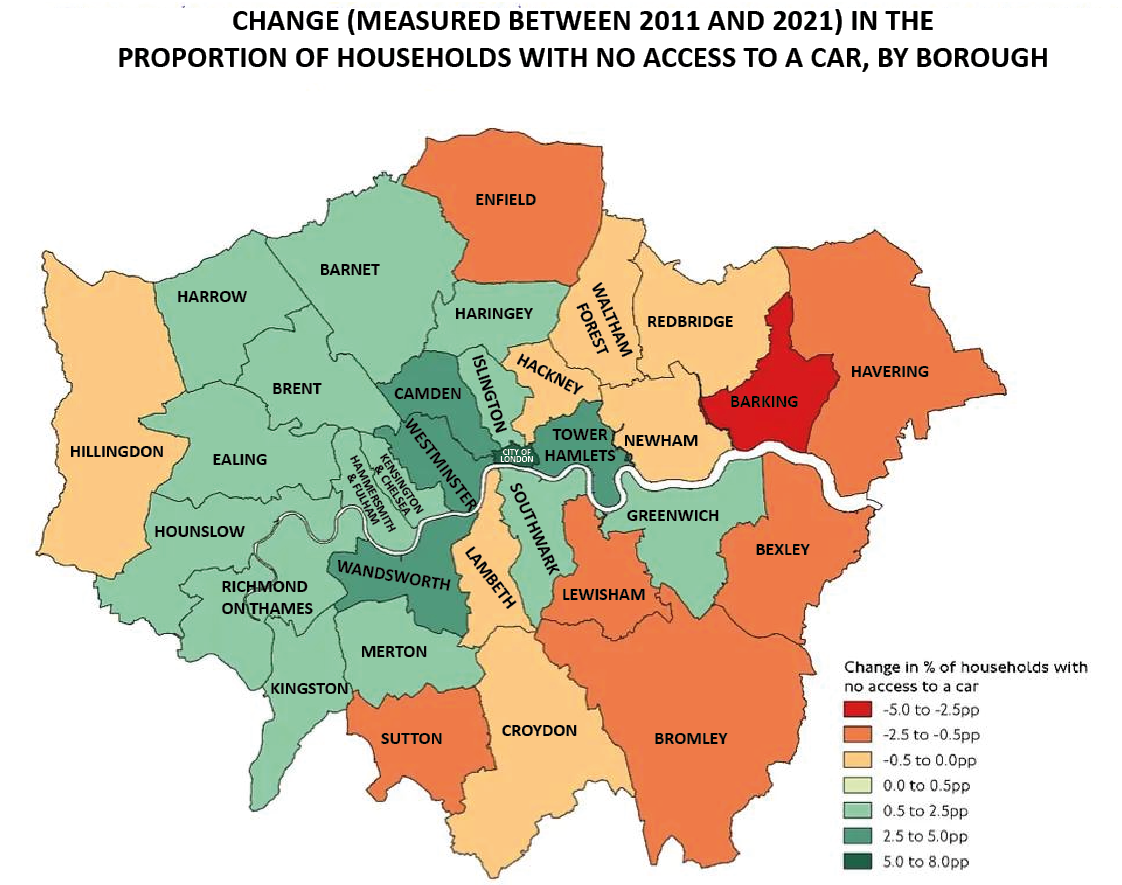
Attached is a map of Greater London Boroughs. Those coloured green are the areas where people are increasingly forced to live without cars altogether. Boroughs in red and orange are where people are becoming more likely to have access to a car. This is creating a growing schism between the capital’s centre and its suburbs in terms of how people get around. In Inner London 62 per cent of households now live without access to a car, compared to just 33 per cent in outer London. If you’re resident in Camden or Westminster or Hackney you’re deeply unusual if you drive around local streets. If you live in Bexley, or Sutton, or Bromley then you’re the weird one if you don’t pop in the car to go to the shops or get to work.
Apologists for the transport class divide – that they caused – say the split is due to the physical make-up of outer boroughs. Lots of big suburban streets mean traffic can flow faster and you’re often further away from a reliable, regular public transport route or a safe cycling route. Without answering why there’s no cycle lane in these “sweeping avenues” as the embittered call them. Or aren’t hosting a 24-hour bus lane given they’re so “big”.
Instead, central London socialists shut down Park Lane as a thoroughfare, with promises to shut down Oxford Street, Kilburn, and Marble Arch in their desire to produce a character-less, car-less, sans-serif Amsterdam in the heart of the world’s leading capital city.
This divergence has major political implications ahead of elections, especially when talking about concepts such as the “war on the motorist”. Inner boroughs with higher public transport usage tend to vote Labour. Suburban boroughs where the car is king, tend to vote Liberal Democrat or Conservative.
With the Tories now condemned as a toxic brand, Reform UK hope to hoover up the centre right vote on Thursday. But without any London-wide transport promises apart from removing all low traffic neighbourhoods on taking town hall power. 20 mph speed limits, 24-hour bus lanes, 24-hour cycle lanes, unaffordable parking, unavoidable yellow cross-hatch junctions, speed humps that damage suspension and crack engine sumps? No, nothing. Even from the party that owes its popularity to being the motorists’ friend.